Content frameworks: why they make posting so much easier
companies that adopt structured decision-making processes see a 20% increase in performance compared to those that rely on intuition alone Harvard Business Review
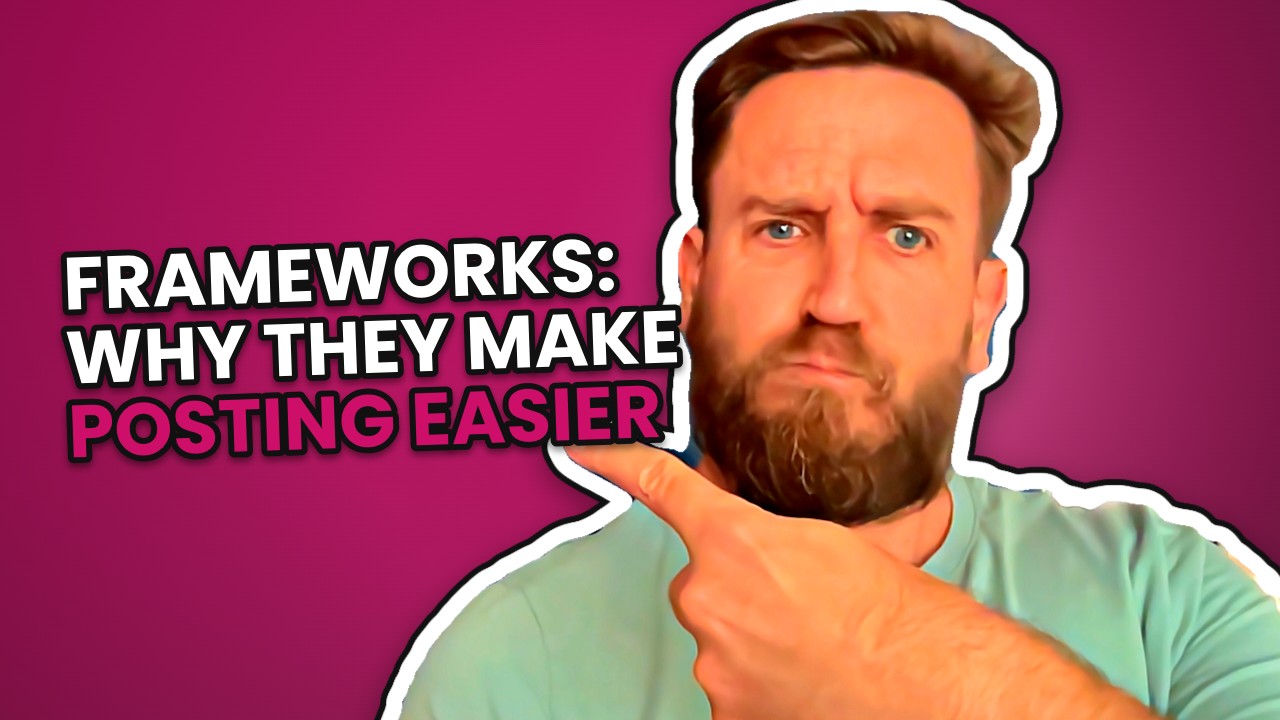
If posting feels hard every single time, it is probably not because you are bad at it. It is because you start from nothing every single time. A framework is just a shape you pour this week's stuff into, and once you have two or three that suit you, the hard part stops being the writing and starts being remembering to take a photo.
I love a framework. Properly love them. I am a massive fan of Shaan Puri largely because he seems just as obsessed with frameworks as I am, except he clearly has the ability to follow them more religiously than I do, on account of being considerably wealthier.
What is a framework, really?
A framework is a proven system that lets you repeat a process. That is it. No mystique, no whiteboard.
You already have them everywhere in your business. The way you quote a job. The order you load the van. The six things you say on the phone to a new customer, in roughly the same order, because you worked out years ago that saying them in that order means fewer surprises later.
Nobody calls those frameworks. They just call it "how I do it". But that is exactly what they are, and the reason they exist is that you got tired of thinking it through from scratch every time.
Social content is the one bit of the business where most owners never do that. Every post starts as a blank box and a feeling of mild dread. Which is mad, because it is the task you have to do most often.
Does having a structure actually make a difference?
It is not just a feeling. Harvard Business Review found that companies that adopt structured decision-making processes see a 20% increase in performance compared to those that rely on intuition alone.
Twenty per cent. For the same people, doing the same work, just with a shape to it. Honestly, if someone offered you twenty per cent more out of your Tuesday for free you would take their hand off.
And notice what it is measuring. Not better ideas. Not more talent. Structure versus intuition. Intuition is lovely when you are on form. The trouble is intuition has a bad back on Thursdays and gets very quiet in December.
The framework is what you use when you are not on form. That is its whole job.
Here is the tangent I keep going round in circles on, and then I will get back to the point. With someone like Shaan Puri, I genuinely cannot tell whether the frameworks made him wealthy, or whether being wealthy gave him the time to follow them properly, because he can do what he wants rather than what everyone else needs him to do. I suspect it is a bit of both and the loop feeds itself.
Which matters for you and me, because we are at the other end of it. We are the ones doing what everyone else needs us to do, all day. We have less slack, not more. So the framework is not a luxury for people with quiet afternoons. It is the thing that makes a loud afternoon survivable.
What does a content framework look like in practice?
Something boringly simple. Three or four shapes you use again and again, each with a job.
Here are the kinds that tend to work for small businesses, and you will recognise most of them:
- The job walkthrough. What the customer had, what you did, what it looks like now. Three beats, every time.
- The question you keep getting asked. You answer it twelve times a month on the phone anyway. Answer it once, properly, in public.
- The myth. The thing people believe about your trade that costs them money. Say the belief, say the truth, say what to do instead.
- The tip. One small useful thing, no build up. Done in forty words.
- The thing that went wrong. Not a disaster, just the fiddly bit nobody warns people about. These get more replies than anything polished.
The skill is not inventing new ones. The skill is noticing which two or three actually suit how you talk and what you have photos of, then reusing them until they are second nature.
Try this: open your phone, look at the last twenty pictures you took of work, and ask which of those shapes each one fits. You will usually find you have a fortnight of posts sat there already, just unlabelled.
Won't the same structure get boring?
This is the fair objection, and it is the one thing I would actually watch.
My own rule of thumb is to find the frameworks that work for me and repeat them, just not so often that they become stale and boring and ineffective. Same shape every single time, in the same order, with the same opening line, and people stop seeing it. The brain files it under "ah, that again" and the thumb keeps moving.
So rotate. Three or four frameworks on a loop beats one framework hammered flat. Change the opening line even when the structure underneath is identical. Swap format too: a walkthrough works as a carousel one week and a thirty second video the next, and to the person scrolling it feels like a completely different thing.
And be honest about which ones earn their place. If the tip posts get replies and the myth posts get tumbleweed, that is useful information, not a personal insult. Keep the ones that land. Quietly retire the rest.
The other thing that keeps a framework alive is that the raw material changes. The shape is a jug. What you pour in is this week's job, this week's awkward question, this week's weather ruining a delivery. Nobody notices the jug.
How do you get frameworks to stick when you are busy?
This is where I will put my hand up: I am not naturally consistent either. Knowing the framework and running it on a bad week are two very different sports.
A few things that help:
- Write them down. Not in your head. On a page, with names, so you can pick one in ten seconds rather than deliberate.
- Keep a scrappy list of raw material. Questions customers ask, jobs worth showing, the thing that annoyed you on site. Five seconds in your notes app now saves twenty minutes of staring later.
- Decide the week before, make on the day. Choosing what to post and writing it are two different jobs, and doing them at the same time is why it takes an hour.
- Lower the bar on purpose. A framework filled in badly and posted beats a masterpiece that never leaves the drafts. Consistency is doing most of the work here anyway, which I have gone on about in why posting consistently matters more now.
None of that is clever. It is just removing the decisions, which is exactly what the Harvard Business Review finding is pointing at. Fewer decisions on the day, better output over the year.
Where Zoshl helps
This is genuinely the bit Zoshl was built for, so forgive me for a minute.
The post types are the frameworks, already written down. Tagline, statistic, quote, tip, question, announcement, what you get, from this to this, picture it, myth buster. You pick the shape, Zoshl writes five options for the line and you choose one, or you write your own.
Carousels work the same way. They are built on proven structures: problem and solution, myth and truth, how to, tips list, before and after. Zoshl picks one that suits the topic and varies it from one carousel to the next, which is the anti-staleness bit I was banging on about earlier.
It is all in your own voice, from what you have told it about the business, in your colours and typeface with your logo. It will not invent a number, a price or a review: figures come only from facts you have recorded with a source, or real facts found on the web for that piece.
And there is an Ideas list for the raw material, so when something worth posting about happens on a Wednesday it has somewhere to live until you get to it. If you want the detail of how any of it works, it is all written up in the help centre.
What Zoshl will not do is take the photo or notice the good story. That is still you. But the blank page, the "what do I even say", the forty minutes of fiddling with layouts: that part can go.
Which brings me back to Shaan and his annoyingly well-followed frameworks. I still do not know which way round the cause and effect runs for him. But I do know that the version of this available to the rest of us is not a life of quiet focus. It is three shapes written on a page, used on a Tuesday, when you really cannot be bothered. That will do.
Questions people ask
How many content frameworks do I actually need?
Three or four is plenty for most small businesses. Any fewer and your feed starts to look repetitive; any more and you are back to deliberating over which to use, which is the problem frameworks were meant to solve. Pick the ones that suit the photos and stories you naturally have.
Won't using the same structures make my posts look generic?
Not if the material inside them is yours. The structure is the jug, your job, your customer question and your photo are what people actually see. Rotating between a few frameworks and changing the opening line keeps it feeling fresh even when the shape underneath is identical.
Is there evidence that structure beats just winging it?
Harvard Business Review found that companies that adopt structured decision-making processes see a 20% increase in performance compared to those that rely on intuition alone. Intuition works well when you are on form; the structure is what carries you through the weeks when you are not.
How do I know which framework is working?
Look at replies and saves rather than likes, over a month or two rather than a single post. If one shape consistently gets conversation and another gets nothing, keep the first and quietly retire the second. That is data, not a verdict on you.
Can Zoshl use my own framework rather than its built-in ones?
You can always write your own line rather than pick from the five options Zoshl suggests, and you can edit the words, pictures and layout afterwards. The built-in post types and carousel structures are there as a starting shape, not a cage.
Sources
- Harvard Business Review, Harvard Business Review, 2024: fastercapital.com/articles/how-to-apply-decision-making-fram...
Make your next week of posts in minutes
Zoshl writes and designs social media posts, carousels and videos in your own voice and colours.
See how it works